I love sequels. There I said it, I really do. With all of the sequels this holiday season, there has been quite a bit of talk about the subject. Most of the discussion revolves around business, how making additions to proven franchises makes more fiscal sense then creating new IP, or how designers aren’t as able/willing to take risks in this multi-billion dollar industry. And even though most of the gamers I have talked to will say that they prefer completely new games to sequels, they tend to buy mostly follow-ups to games they already know they like. I really don’t want to talk about business or hypocrisy through; of course companies will do things that make money, and people think one thing and do another all the time. Why do sequels sell so well? Why do people who profess to want new gameplay keep picking up sequels and then decry them as ‘derivative’ or ‘recycled’.
The short answer is that we want to recreate a pleasant emotional moment. As 3rd dimensional beings traveling linearly through the 4th we place mental bookmarks on significant points in our lives (I know, I know, just bear with me here). Whether it was a first date or that time we embarrassed ourselves in front of the whole class; we have strong emotional attachments to these experiences that allow us to better recall them. It’s not just significant events either; food that we liked, music we listened to, a movie that absolutely blew us away; all of these things represent something placed in our personality time capsule. Our thirst for nostalgia represents our desire to reconnect with our past selves, to touch base with the things that shaped our lives.
This is the problem with sequels, we don’t just want to recollect a pleasant memory, we want to recreate it. For us, its simply not enough to just replay Bioshock; the twists are all known and big daddies aren’t nearly as scary the second time around. So we sign up for the sequel, it will be the same essential game, but with new content, new twists and new baddies; and yet Bioshock 2 only served to remind us of how much we loved the original Bioshock (or System Shock ya’ big nerd). When I played Batman: Arkham Asylum, I was taken completely by surprise, it was fresh, innovative, and very, very Batman. When Arkham City came out I was duly excited, but many reviewers talked about how the game just isn’t as special this time around, and that the surprise of how good of a game Arkham Asylum ended up being was a big part of why we loved it so much. So why is it that we don’t we love sequels as much as the originals they are based on?
Thankfully, there is a graph to explain all of this; it is called the Kano Model.
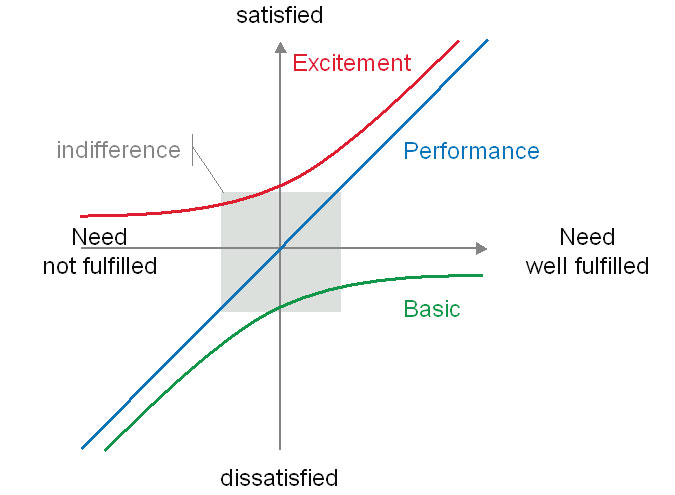 This graph is designed to chart features of a product by placing them on one of three curves: excitement, performance, and basic. When a feature is entirely new and unexpected, it can’t help but elicit a positive response because there is no baseline expectation for it. At worst, something new is met with indifference (meh…), at best it represents surprise and delight (wow!). When an excitement feature loses its novelty, it becomes a performance feature, an iconic attribute, we expect Call of Duty to have tight controls and Mario Galaxy to have well-designed levels. These features can still delight, but not as much as completely novel ones. They can also disappoint if done poorly, because the audience expects a certain level of quality out of those features. When a performance feature becomes standard across the industry, it becomes a basic feature. This is something we rarely laud and only mention if it disappoints us. We expect games to be bug free and for cameras to follow our characters fluidly. At best these features are ignored, at worst they frustrate or enrage the user.
What’s the point of having a graph without charting some stuff on it though, let look at critics’ darling, Uncharted 2 (mostly because charting Uncharted sounds like fun).
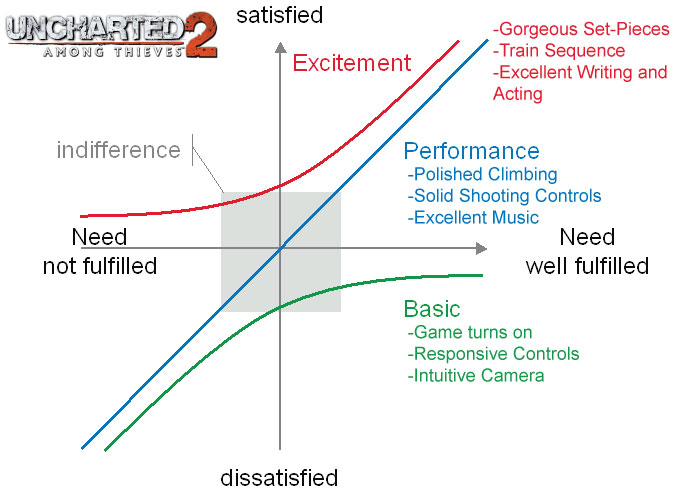 While Uncharted 2 is not the first in the series, many of you will agree that this is actually the definitive Uncharted game. Uncharted 2 wowed critics and players alike with its dramatic set pieces, cinematic flair, and punchy storytelling. Sequences like the train level and collapsing buildings were real wow moments the genuinely surprised us when we first played them. Uncharted 2 also had a great shooting and climbing system. While 3rd person shooting and climbing had been done in other games before as well, Naughty Dog proved it could do them as well as anyone else. Lastly the game was on a basic level perfectly competent, it ran properly, the load times weren’t too long, and the character moved where we wanted him too.
When we look at Uncharted 3 on this same graph, we see why reviewers are reporting it to be of the highest quality, but some say it lacks the same surprise and delight as Uncharted 2.
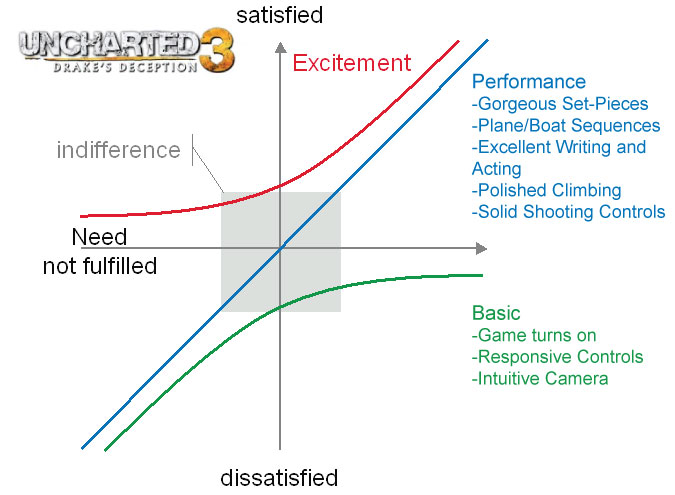 Even though Uncharted 3 is still way ahead of the competition, the cinematic set pieces, while amped up this time around, are an expected affair (I cannot emphasize enough here that I am in no way disappointed in UC 3). They fall well on the high point of performance, but they are still no longer a novelty. The new addition to Uncharted 3 is arguably its multiplayer; which, excellent as it may be, is derived from other similar online shooters, so it cannot rise above the limits of the performance curve. Most of the focus of Uncharted 3 is on the performance of its key established features rather than the novelty of new ones. So while Uncharted 3 has the power to impress, and it does, it would be unfair of us to expect it to wow us as much as Uncharted 2. And yet we demand that sequel be made anyway.
So we purchase sequels because we want to replay the original with fresh eyes, but that is impossible because its not just the game itself that is old hat to us, but the features themselves. This is why I chose the Uncharted series as an example here. The first uncharted is by all means a good game, but the second succeeded over its predecessor by being a better representation of Uncharted’s core themes, so much so that it became the definitive game in the series. Uncharted 2, rather than copying everything that Uncharted was; instead focused on what the series was about and created new features that better reflected that particular style. This is perhaps why Bioshock: Infinite has chosen to do away with oceans and big daddies and instead create a whole new game in the style of Bioshock, almost as if there were creating a game inspired by the previous effort rather than a true sequel. Bioshock: Infinite is hotly anticipated, and yet, bears only thematic ties to the original Bioshock.
So we consumers purchase sequels out of a sense of nostalgia, but we criticize them for not living up to those expectations. While we say we want new, what we really want is to experience the delight we felt when our favorite things were new, thus causing us to chase the familiar while being disappointed with its familiarity. It is impossible to play Ocarina of Time again for the first time, and yet that is the thing I want the most in a game. So perhaps a sequel is best served by trying to do just that, recreate an experience at a deeper more thematic level, rather than a surface gameplay one, but maybe that is too much for us to ask. Frankly it is pretty hard to reinvent the wheel every time.
In conclusion, games are like any other media, they are all about how they make us feel, whether it’s Mario Kart, Madden, or Doom; we bring ourselves and our pasts into our gaming experience. Knowing that Arkham City was going to be a lot like Arkham Asylum and accepting that, helped me enjoy it more and worry less about whether I was getting the same gameplay.
It seems apropos that so many sequels come out during the holiday season, a time of the year almost entirely devoted to remembering past glories and trying desperately to recreate that perfect Christmas morning. My advice, unwrap your copy of Best Game Ever 3 (even if it’s not as good as the first or second one), eat your favorite holiday foods (even though they really aren’t that tasty anymore), and turn the radio to your local all holiday music station (even though, let’s admit it, the songs are all terrible).
oh… and call your mother dammit!